
Pavlova recipe with a crisp, crack-free shell and a soft marshmallow center, topped with whipped cream and fresh berries.
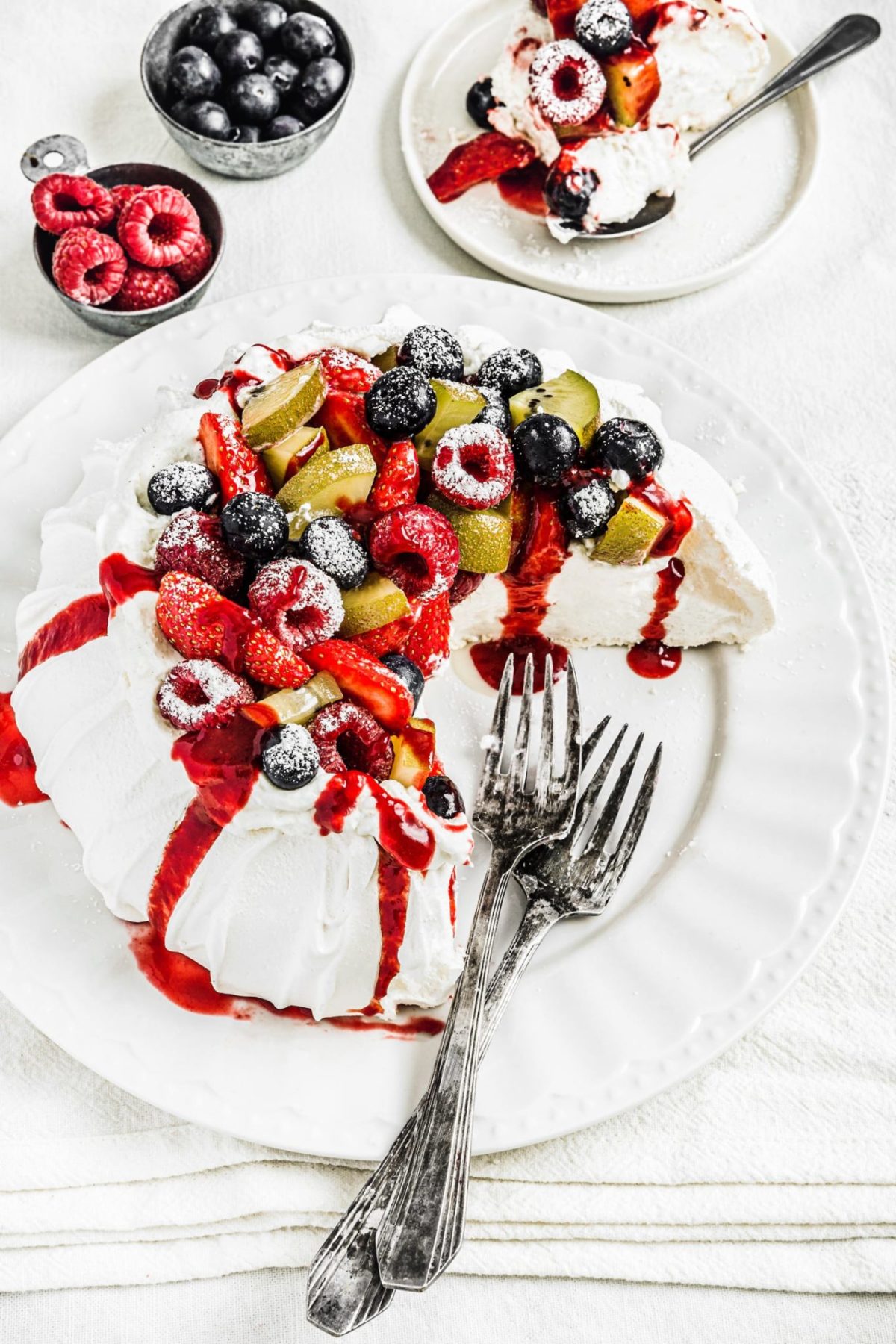
This pavlova recipe uses a French meringue method, the technique I rely on as a French baker to get a stable shell without cracks.
After many tests, this method gives a light, airy pavlova that holds its shape and doesn’t collapse after baking.
It’s my go-to pavlova when I want clean edges, a soft center, and a dessert that slices beautifully, even with berries on top.
Why you’ll love this pavlova
- Crisp shell with a soft marshmallow center
- Crack-free thanks to the French meringue method
- Easy to top with berries, cream, or citrus
Ingredients you need
- Egg whites: Large egg whites at room temperature for a light, voluminous pavlova shell.
- Granulated sugar: Fine white sugar for a smooth, stable French meringue.
- White vinegar: Helps stabilize the meringue and keep the shell crack-free.
- Cornstarch: Creates the soft, marshmallow-like center.
- Vanilla extract: Adds gentle flavor to the meringue base.
- Mascarpone cream: Cold mascarpone, heavy cream, powdered sugar, and vanilla.
- Fresh berries: A mix of red berries works best for topping.
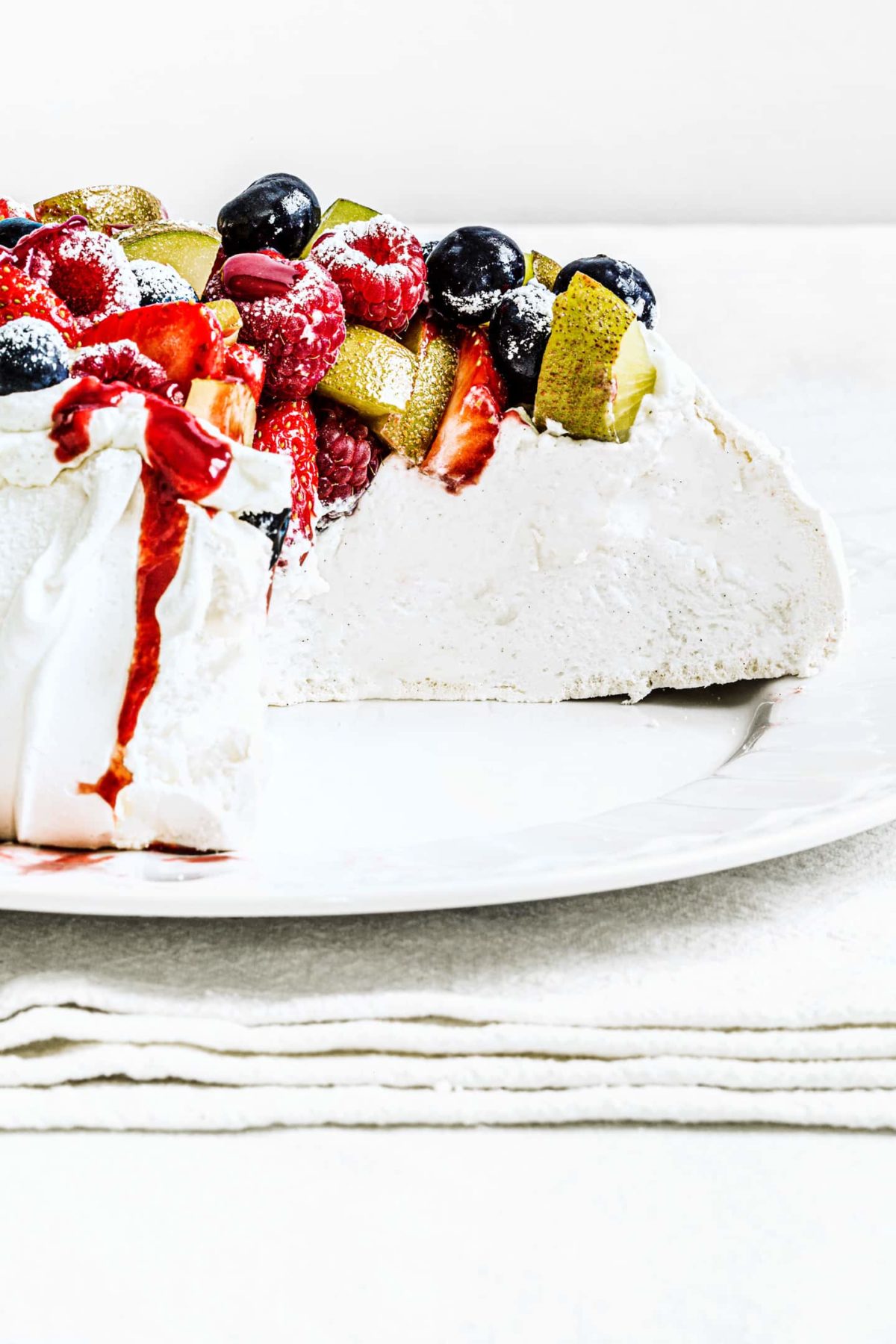
Why French meringue works for pavlova
French meringue is the method I use for pavlova because it creates a light, crisp shell with a soft, marshmallow center when baked gently.
The sugar is added gradually to the egg whites, which helps the meringue hold its shape without becoming dense or chewy.
As a French baker, this is the technique I rely on for smooth pavlova shells without cracks, with a clean finish and a delicate texture.
How to make pavlova (French meringue)
This pavlova is made using my French meringue method, where egg whites and sugar are whipped together until glossy and stable.
Whisk the room-temperature egg whites with vanilla on low speed until foamy.

Increase to medium speed and beat until soft peaks form.

Add the superfine sugar gradually, one tablespoon at a time, mixing on low speed until fully incorporated.
Beat on medium speed until the meringue is glossy and smooth.
Test the texture by rubbing a little meringue between your fingers; it should feel completely smooth.
Add the cornstarch and vinegar (or lemon juice), then whip on high speed until stiff peaks form.

How to shape a pavlova shell
Draw an 8-inch (20 cm) circle on parchment paper and place it on a baking sheet, pencil side down.
Spoon the meringue into the center of the circle.
Shape with a spatula or spoon, forming higher edges and a slight dip in the center to hold the filling.

Baking tips for perfect pavlova
- Let it dry completely before topping to keep the shell crisp.
- Bake low and slow to keep the pavlova white, crisp on the outside, and soft inside.
- Do not open the oven door during baking, or the meringue may collapse.
- Turn the oven off and let it cool inside to prevent cracks and sudden temperature changes.
- Avoid humid days if possible, as moisture can soften the meringue.
- Bake on the middle rack for even heat circulation.

Berry topping for pavlova
- Use fresh berries for the best texture and flavor: strawberries, raspberries, blueberries, and blackberries work well together.
- Add the topping just before serving to keep the pavlova shell crisp.
- Slice larger fruits like strawberries so the topping is easy to cut and serve.
- Balance sweetness with naturally tart berries or a small splash of lemon juice.
- Optional finish: a light dusting of powdered sugar or a spoon of berry coulis for extra color and shine.
How to assemble berry pavlova
I like to top this pavlova with my mascarpone frosting for a light, stable cream that holds beautifully under the fruit.
- Cool the pavlova completely before adding any topping.
- Spread the mascarpone whipped cream gently in the center, leaving the edges visible.
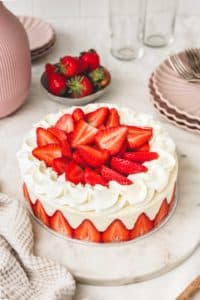
- Top with fresh berries just before serving for the best texture.
- Finish with coulis or powdered sugar, if using.
- Serve immediately to keep the shell crisp outside and soft inside.
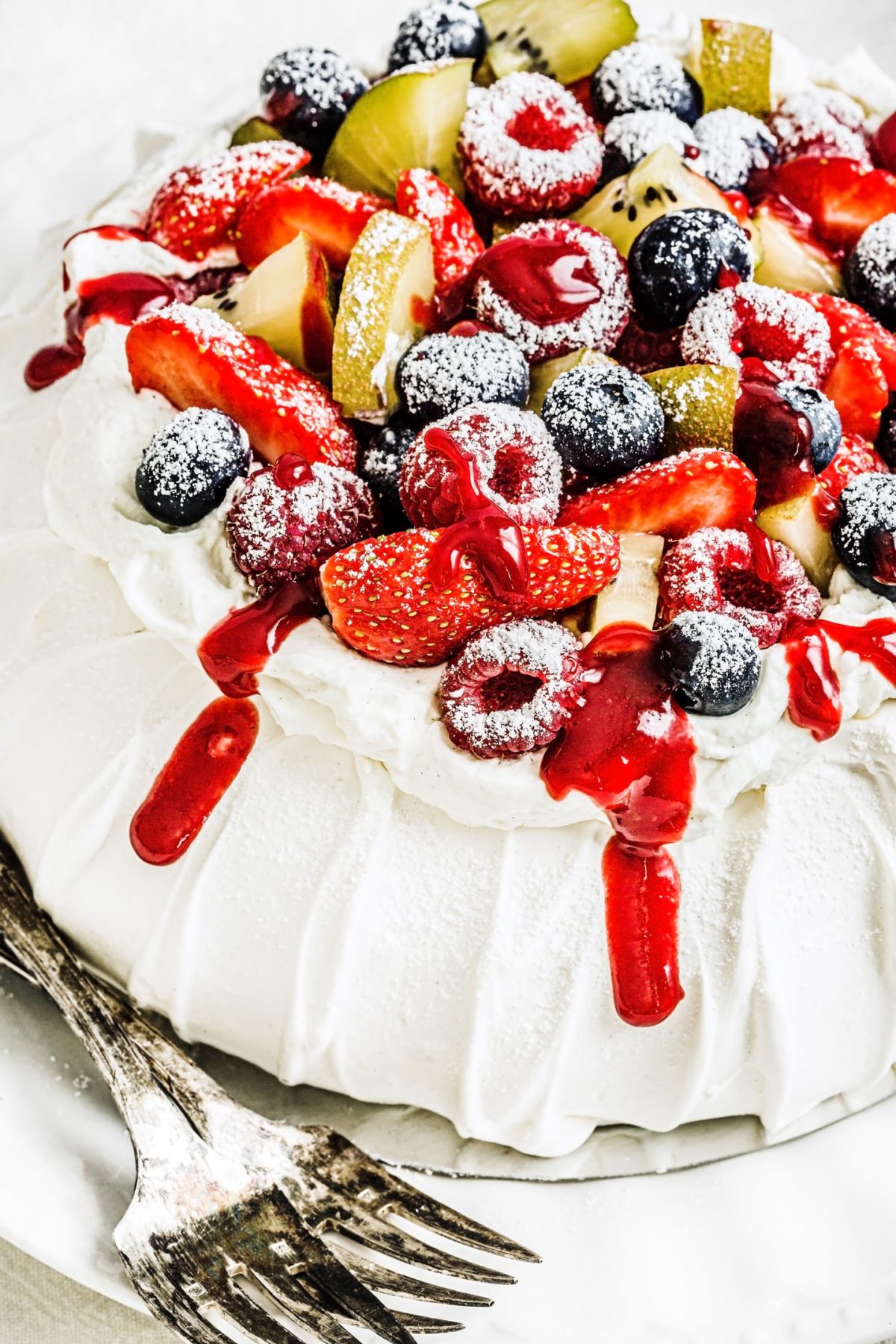
Serve with fresh berries and a drizzle of homemade raspberry coulis for extra freshness.
Storage
- Ungarnished pavlova: store at room temperature in a dry place, lightly covered, up to 24 hours.
- Assembled pavlova: keep in the refrigerator and serve within 2–3 hours for best texture.
- Leftovers: once topped, the meringue softens quickly and does not keep well.
- Freezing: not recommended, the texture becomes sticky after thawing.
Recipe Variations
- Individual servings: assemble just before serving for clean slices and crisp texture.
- Mini berry pavlovas: pipe or spoon small nests and reduce baking time.
- Lemon pavlova: add a layer of lemon curd under the mascarpone cream.
- Tropical fruit pavlova: swap berries for mango, passion fruit, and kiwi.
- Chocolate pavlova: drizzle with melted dark chocolate before serving.
For individual servings, you can use the same method to make meringue nests, perfect for mini pavlovas.
Pavlova Troubleshooting & FAQs
Why did my pavlova crack?
Small cracks are normal. Large cracks usually come from baking at too high a temperature or cooling the pavlova too quickly. Let it cool slowly in the turned-off oven.
Why is my pavlova soft or sticky?
Humidity, underbaking, or adding the cream too early can soften the shell. Always assemble just before serving and store the baked meringue in a dry place.
Can I make pavlova the day before?
Yes. Bake the pavlova shell a day ahead and keep it at room temperature, unfilled. Add the mascarpone cream and berries right before serving.
Can I use frozen berries for pavlova?
Yes, but thaw them completely and drain well. Frozen berries release more moisture, so add them just before serving.
How do I know when pavlova is baked?
The outside should be dry and crisp, and the pavlova should lift easily from the parchment paper while staying soft in the center.
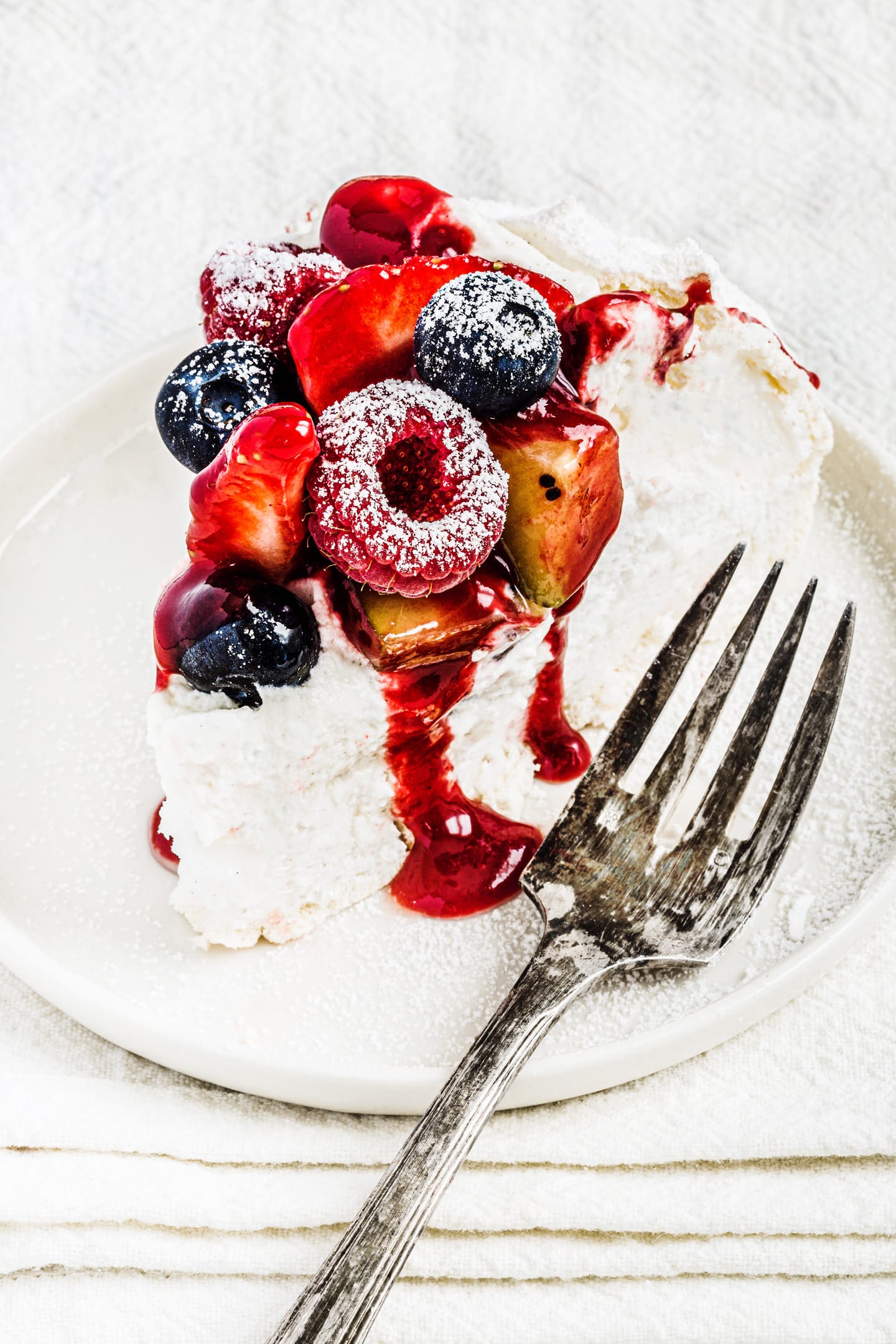
More Meringue recipes
I hope you’ll love this recipe! Rate it ★★★★★ and leave a quick comment — it always helps. Happy baking!
Print
Pavlova Recipe with Berries and Mascarpone
- Total Time: 2 hours
- Yield: 10 parts
Description
Berry pavlova with a crisp meringue shell, soft marshmallow center, mascarpone whipped cream, and fresh berries (for one 8-inch / 20 cm pavlova).
Ingredients
Meringue base
- 200 g egg whites – at room temperature (about 6–7 large egg whites)
- 320 g (1⅓ cups) superfine sugar
- 1 tablespoon cornstarch
- 1 tablespoon white vinegar or lemon juice or cream of tartar
- 1 teaspoon vanilla extract
Mascarpone whipped cream
- 100 g (4 oz) mascarpone – cold
- 200 g (⅔ cup) heavy cream – full fat and cold
- 2 tablespoons powdered sugar
- ½ teaspoon vanilla extract
Fruit topping
- Fresh berries – raspberries, blueberries, blackberries
Instructions
Pavlova meringue
- Prepare a sheet of parchment paper and draw one 8-inch / 20 cm circle using a plate as a guide. Place the parchment on a baking sheet.
- Place the egg whites and vanilla extract in the bowl of a stand mixer fitted with the whisk attachment and whip on low speed for about 5 minutes, until foamy.
- Increase to medium speed and whip for about 5 minutes, until soft peaks form.
- Reduce to low speed and gradually add the superfine sugar, one tablespoon at a time, allowing it to dissolve fully (about 10 minutes).
- Once all the sugar is incorporated, switch back to medium speed and whip for another 10 minutes, until the meringue is glossy.
- Rub a small amount of meringue between your fingers to check that the sugar is fully dissolved. If grainy, continue mixing for 5–10 minutes more.
- Add the cornstarch and vinegar (or lemon juice) and whip on high speed for 1–2 minutes, until stiff, shiny peaks form.
- Spoon the meringue onto the prepared baking sheet and shape it into a pavlova nest, keeping slightly thicker edges.
- Preheat the oven to 248°F / 120°C and place the pavlova on the middle rack.
- Lower the temperature to 230°F / 110°C and bake for 90 minutes without opening the oven door.
- Turn off the oven and let the pavlova cool inside for at least 1 hour, or overnight for best results.
Mascarpone whipped cream & assembly
- Place the cold heavy cream, powdered sugar, mascarpone, and vanilla extract in a bowl.
- Whip with a hand mixer on low speed, then gradually increase to medium speed until thick and smooth.
- Carefully place the cooled pavlova on a serving plate.
- Spread a generous layer of mascarpone whipped cream over the center.
- Top with fresh berries and serve immediately, optionally with fruit coulis and a light dusting of powdered sugar.


Notes
Storage: Pavlova shells keep at room temperature in a dry place for up to 24 hours; assemble with cream and fruit just before serving.
Tips & notes
- Use a kitchen scale for accurate measurements and consistent results
- Egg whites must be completely free of yolk or fat
- Superfine sugar is essential for a smooth, stable meringue
- Do not open the oven during baking or cooling
- Assemble the pavlova at the last minute to keep the shell crisp
- Prep Time: 30 minutes
- Cook Time: 1 hour 30 minutes
- Category: cake, Dessert
- Method: baking
- Cuisine: australian
Nutrition
- Serving Size: 1 slice
- Calories: 154
- Sugar: 6
- Sodium: 48
- Fat: 12
- Saturated Fat: 7
- Carbohydrates: 40
- Protein: 3
- Cholesterol: 37

Julie
Hi, once the pavlova are set up with mascarpone whipped cream and fruit, how long can they be kept in the fridge? Thanks J.
Fadela
Hello, they should be eaten immediately, the meringue will absorb the liquid from the fruit and the coulis and will soften. The best is to keep the meringues at room temperature and garnish them just before serving the dessert.
Freda
Hello,
Thank you for your recipe! I love your blog, everything is well explained!
I made the pavlova, but when I tried to move it to a dish... it started to break...
Is this because I used room temperature egg whites (where you mark fresh eggs (fridge)) is that right?
Thank you for your answer and wish you a happy holiday season.
Fadela
Hello and thank you for your feedback ❤️. Pavlova is a very fragile dessert and you have to handle it carefully even if you let it dry overnight in the oven. Regarding the egg whites, fresh and not cold, it is simply eggs that are not several days old.